Victoria's Blizzard of '96
Tee shirts do not often commemorate weather events, but the new year of 1997 brought a brisk sale of tee shirts in the region of Victoria, British Columbia. They proudly stated in a variety of colours and phrasings: "I Survived The Blizzard of ‘96." And while many (including me) might argue this storm was neither a blizzard nor the disaster proclaimed by the media, the snows that blanketed Victoria and surrounding countryside from December 21 to early January put many residents of southern Vancouver Island into an uncomfortable survival mode. 1996 was my fifth winter in the Victoria district. As a former resident of the Great Lakes region, I was no stranger to heavy snowfalls and prolonged disruption of regular life patterns by snow. I had coped with the heavy snows and frigid temperatures of the 1976-1779 period around the Great Lakes, making it to work and play without too much difficulty. I had been snowed in several times at home and while travelling and viewed such events with the philosophy: "this too shall pass." 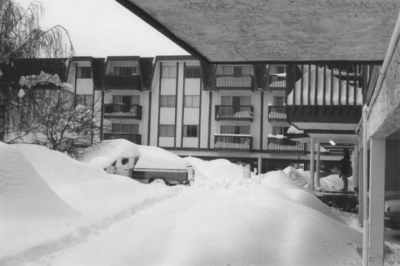 When the first flakes began to fall on the morning of December 21, 1996, I was only concerned about my son cycling to work, but he had cycled in winter in Ontario many times and assured me he did not think much about it. But as the day progressed, the snow began to fall heavily. Large, wet flakes that quickly built up a snow duvet 20-30 cm (8-12 inches) thick by sunset. In late afternoon, I received a call that Derek had forgotten his bike light and asked me to pick him up at work, his concern not being the snow but the darkness. With my mind on Ontario winter a la mode, I drove off to get him, taking it slow and constantly watching for other drivers. The final kilometres to the restaurant required a rather steep descent with a sharp turn at the bottom. Unfortunately, my concern for the curve was premature, for a hundred metres before it, I began to slide on the slippery undersurface and ended up off the road, firmly lodged in a snowbank on the edge of a ditch. Finding someone to assist me in extracting the car from the snowbank, I moved to the front of the car to push it out. My second step beyond the front bumper led to a drop that left my chest even with the front grill. I had been fortunate indeed that the deep snow had stopped me just short of calamity. My vehicle extracted, I continued my trip and, with Derek and bicycle on board, completed a very cautious, back-street return home. The 16 kilometre (ten-mile) round-trip required nearly three hours. At the conclusion of the day, my thoughts leapt at the prospect that we might actually have a white Christmas, with a foot of snow four days before the 25th, it seemed a lock. But, I live in the Canadian climate anomaly known as Victoria, and in the interim, the temperature soared above freezing. Thus, with lawns rejuvenated by the wet snow more than harmed by it, Christmas Day dawned lush wintergreen instead of white. The next day, my annual ritual, a Boxing Day run, gave me a wet but unfrozen turf and chip trail with only glimpses of snow cowering from the sun deep within the blackberry brambles. Little did I know the weekend surprise that would soon emerge. Waking the morning of December 28th to the sounds of surprise on the street below, we were greeted with a white visage beyond window panes covered in dripping condensation. The predicted snow had fallen overnight, and the cityscape outside our windows revealed a winter wonderland. The snow, however, continued to fall and fall heavily. Every cloud that rolled over us was pregnant with this unusual solid white water and more than willing to litter all over the landscape. By mid-afternoon, it was obvious that in a city not accustomed to snow, driving was not a good idea, and my friend Charlene decided the city bus was the best alternative to take her home. We slipped down to the bus stop just in time to see a bus inching down the hill toward us. The deep snow prevented the bus from stopping curbside, so the driver halted in mid-street. My first step toward the bus to help Charlene aboard, landed me in knee-deep snow — my foot caught in the slushy white like a spoon stuck in thick mashed potatoes. Derek and I whiled away the evening hours mesmerized as the snow poured unceasingly forth from the low-hanging clouds and buried most surface details below our windows. The forecast called for continued heavy snowfall overnight, but I do not think we truly understood what was in store for us as we snuggled into warm beds for our winter night's nap. When my mind came to consciousness in the pre-dawn hours, I was shaken by something eerie in the darkness. What was that?….Silence!?! Normally, traffic and city buses on the streets below tell me morning is nigh. But this morning, nothing outdoors broke the acoustic peace. 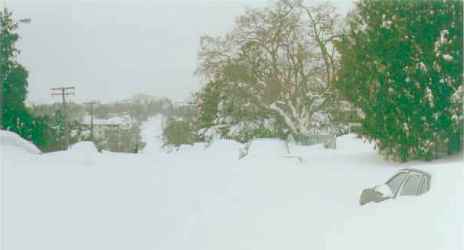 When morning broke, the coastal city of Victoria was literally drowning in a sea of snow. The snow fell on cedars, Douglas firs, arbutus and Gerry oak alike. The streets were uniform covers of white broken only by human tracks. Most of the cars in the apartment parking lot were, well, gone from sight, only oddly shaped mounds hinted at their continued presence. As former eastern Canadian residents, Derek and I marvelled at the scene and then sat back to enjoy an enforced quiet day. Living in an apartment, we had no realization of the magnitude of the event stretching ghostly beneath our windows. Sure, streets were closed, but that was well within our experience, and in hours, we believed, the plows would begin clearing them for traffic. Back east, municipal snow-removal crews would be battling away even as the snow fell, opening first the main arteries and then the smaller streets and taking a few days at most to have the situation back to normal. But in Victoria, nothing much moved on wheels this day nor for several days afterward. 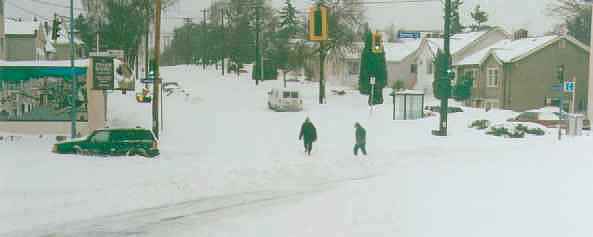 Intrigued by the sights from my balcony, I ventured forth that December 29th afternoon to better inspect the scene from ground level. The photographs accompanying this article are my visual record of the neighbourhood scene that day (plus a few from a week later when most snow had melted). Ironically, my cross-country skies were wrapped in a tarp and stored on my apartment balcony under my bicycle. The balcony, however, was filled with over a metre of snow, a mound I did not attempt to tackle with my dustpan shovel. By the time I was finally able to extricate them, the snow had melted enough to render them useless. 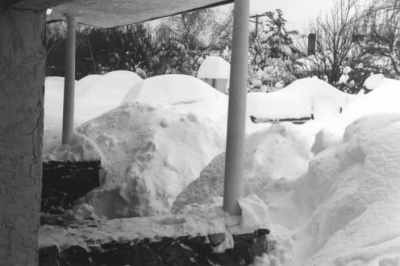 As a result, I trudged through the snow in a circuit around the block. A taxi was caught in our driveway entrance; a house had its front porch buried in snow and completely blocking the doorway. As I worked my way along Glasgow Street, I happened to look down as I pulled my foot out of the deep, wet snow. Near my boot, I noticed a shiny object I soon realized was the side-view mirror of an automobile parked along the street. It was buried to its roof in the snow. 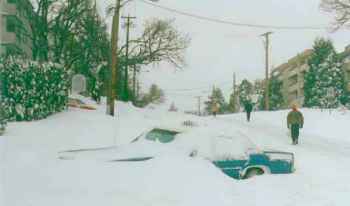 While the snow tapered to light flurries, the latest weather forecast for the next 12 hours had good and bad news. While telling us that the heavy snowfall was over, it also warned that 20-30 mm (about an inch) or more of rain might fall over the Greater Victoria district. Adding rain to the heavy wet snow already fallen further heightened the possibility of roof collapse and other damage around the city. 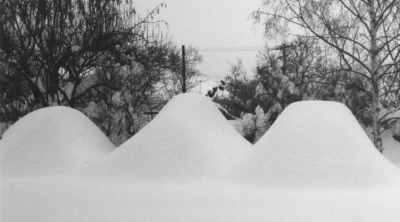 I personally became worried that the combined weight might force open a crack in my car's sunroof and cause water damage within the vehicle. I determined I must go out to clean its roof of snow. (The mound to the right in the accompanying photo is my car, the one to its left is a Volkswagen Beetle.) The snow depth next to the car was halfway up my thigh and so packed that any thoughts of opening a door where quashed. With great difficulty — including stepping out of my boot and into the cold, wet snow pudding on several occasions — I managed to clear the rooftop of its snow cover using a dustpan for a shovel. Since I work at home, I often do not venture forth from my apartment into the normally wet winter weather for several days at a time. Therefore, I do not easily succumb to cabin fever. I had a good food supply on hand so I just sat back and enjoyed the peaceful sounds of silence emanating from the streets beneath my window for the next several days. But within the Capital Regional District, all was not as serene. The Storm's ImpactHere in Victoria, snowfalls above 10 cm (4 inches) are rare, and in this particular situation, Mother Nature had taken the upper hand on local civilization. By the time the snow had tapered to a few flurries and changed to light rain, the official total snowfall measured a record two-day total of 124 cm (48.8 inches) and a 24-hour snowfall of 64.5 cm (25.4 inches) on December 28-29, a local record as well. 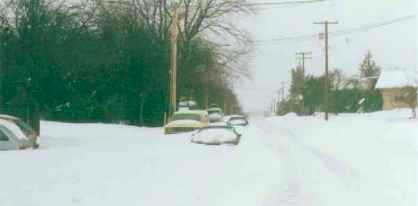 The media called it the Blizzard of 1996, although with heavy snowfalls so rare here, The Blizzard would have sufficed. (The last major snowstorm of comparable size struck in 1916.) The rest of Canada had a rare opportunity for "reverse-gloating" when they heard the news — Victorians can be rather smug about their mild winters and take every chance to rub it in to the rest of the nation. The media also called it a "disaster," but that, in my opinion was an exaggeration. If the storm was a disaster, it would be for its impact on local buildings and infrastructure. Damage and clean-up costs were pegged at around $200 million Canadian dollars. Insurance claims of $120 million were the largest for a single event in British Columbia history. Only one death was officially attributed to the storm: a navy lieutenant who died of carbon-monoxide poisoning while sitting in his idling car whose exhaust pipe became clogged by the heavy snow. I also heard reports of an older gentleman who had succumbed to a heart attack while trying to shovel the snow from his property. Although I sympathize with the grieving families, these deaths could have been avoided with a little common sense. 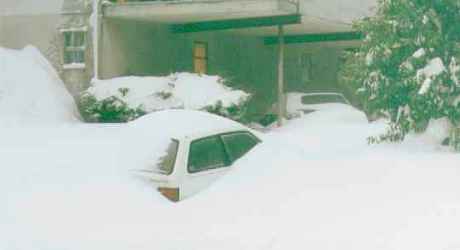 I term the event a transportation emergency since the accumulated snow prevented people from going where and when they pleased. Even four-wheel drive vehicles could not negotiate the deeply covered streets. The hardy took to walking or skiing. The greatest concerns arose when emergencies occurred, and police, emergency vehicles and medical attention could not get to the site because of the snow-clogged streets. Victoria has but a few snowplows (five at the time), and most are attached to the centre of dump trucks, a viable method of snow removal in the normal light snows but of little use in deep snow accumulations since the trucks could not drive over the snow in front of them. Not only did mechanized surface transportation stop, but Victoria International Airport and the BC Ferry service to the mainland and surrounding Gulf Islands also ground to a standstill. Staff could not reach the terminals nor could any passengers get to or from the airport and ferry terminals. Boating was possible if you could get to one, but before you could embark, the decks had to be shovelled free of the heavy snow to avoid capsizing. Many protective boathouses collapsed under the immense weight of the snow, trapping and often damaging the boats within. The various levels of government (Victoria is the Provincial capital) were slow to react to the gravity of the situation. As a result, a local and popular talk radio station CFAX voluntarily undertook organization of the community response, initially through default but later because word had reached many citizens to tune to them for emergency information. (CFAX would later be cited with a special award from the Canadian Meteorological and Oceanographic Society for their efforts during the situation, an award for which I nominated them.) 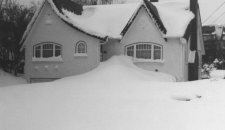 CFAX's open phone line manned by announcers Mike King and Greg Morin connected those in need with those who could render assistance. For example, up the Saanich Peninsula, a seniors' housing complex was literally snowed in. Snow drifted around the building prevented doors from being opened, and many of those trapped within became frightened. One elderly woman phoned CFAX emotionally asking for anyone with a shovel and within walking distance of the complex to help dig out the seniors. Within hours, a small squad of neighbours descended to clear the doorways of snow. The overall reaction of the citizens of Greater Victoria was one of cooperation within neighbourhoods, offering what help could be delivered. Neighbours joined together to shovel snow from roof-tops, doorways, walkways and even full street. They shared food, medicines and other supplies. They offered companionship to those caught alone or frightened. Since snow in Victoria is so rare, many residents don't own a snow shovel so in lieu of the proper equipment, people used cake pans, plates, platters, baking sheets, dustpans, and cardboard boxes to create paths through the snow. Others just waded out and stomped trails into the snow. All neighbourhoods were not as cooperative as others, unfortunately, and some major disagreements arose over the use of the few single-lane roadways dug out by hand shovelling, as addictions to tobacco, alcohol and the automobile overcame common sense and forced mad trips to the nearest stores. 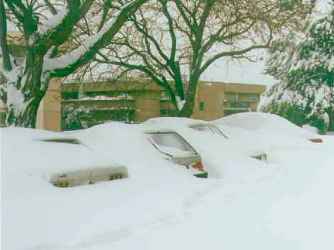 But, those who made it to a store usually found it closed. In those stores, mostly small convenience stores, able to be open, runs on food items quickly cleared shelves. In many cases, empty shelves could not be restocked for more than a week as post-holiday deliveries were stalled by the snow. Supply trucks were caught on the mainland awaiting the resumption of ferry services to the islands and a reopening of highways from the ferry terminal into town. Hospital and nursing home staffs on duty during the storm were trapped and required to take extra shifts. Many Victorians could not obtain critically needed medications because there were few ways to connect supply with need. 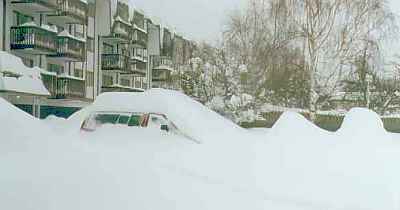 Those businesses — restaurants, shopping malls, groceries — that might have been open during the mid-holiday period were forced to remain closed because employees could not negotiate the trip to work. Bakeries dumped thousands of dollars of bread and dough when the bakers could not reach work nor the baked bread be delivered. Dairy farmers were forced to dump their milk for several days because it could not be taken to the dairies for processing and distribution. The storm wrought major damage to many buildings and utility structures around the region as the weight of the waterlogged snow collapsed roofs, sports bubbles, boat houses, carports and greenhouses. A number of boats sank under the weight of snow on deck, and several float homes capsized or sank. Many of the region's fragile greenhouses, private and commercial, were crushed under the burden of the snow, destroying not only the structure, but the crops growing within. Some specific incidents included:
The storm had some unexpected side benefits in addition to community cooperation. The one most commented upon by Victorians was the quiet. I know my first reaction on awakening that morning was the lack of the urban clamour. Without the unceasing din of traffic, natural sounds wafted across the city. The barking of California seals wintering on several small islands off Victoria's east coast was heard many kilometres inland.
|
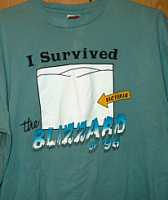 Today when I opened my tee-shirt drawer (the prime uniform for this work-at-home writer), the shirt I pulled out commemorated the Great Victoria snowstorm of December 1996. Even for a dark, early December morning, the math was simple: a few weeks from now would mark the fifth anniversary of that event.